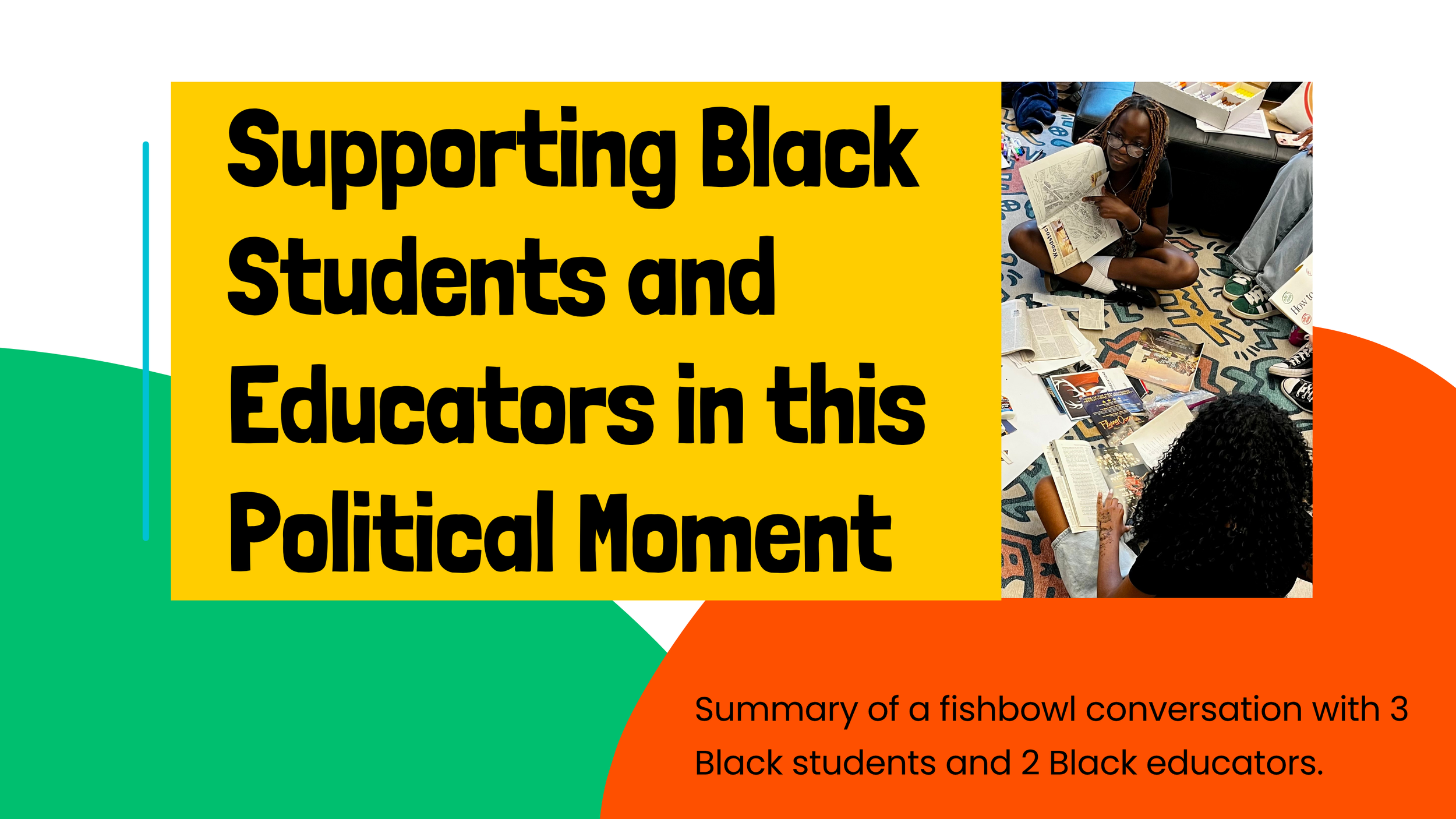
Supporting Black Students and Educators in this Political Moment
In late May, the VT Educators of Color Association hosted an event for our Educator of Color Affiliate Network on supporting Black students and educators in this political moment. Two Black educators and three Black students joined us to explore the following questions:
How does having teachers and staff of color impact your educational experience?
What challenges do you see students of color and educators of color facing in the current political moment and school system?
What policy and systems are currently working well to support Black students and educators in your school district?
What support do you dream about having for yourself or for your peers in the future? What would a school system look like if part of its roots were to support Black students and educators?
Here are highlights from the fishbowl conversation:
The conversation was introduced with a quote from the book Solidarity with Children by Madeline Lane-McKinley: “Which children get to be innocent? Which children get to be seen as children?” Mikaela, a Black educator, explained how there are aspects of dehumanization in schools and communities that impact us all. “When some kids are seeing that others are being treated as less, it impacts everyone.”
What are some of the issues?
Racist Remarks
All three students recounted racist comments they often heard during lunch and in the halls and explained how no one calls them out. “People say things a lot as jokes or to be funny without realizing the impact of their words.” The internet enforces racism and allows people to practice it in anonymous ways. Because people are seeing and hearing derogatory language on the internet, they become desensitized to the harm that the language causes. “People are very different online than in person and it’s accentuated in the newer generation”, student E said.
Disparities in Discipline
Referring to how progress has gone backwards since the “Black Lives Matter” movement has become less prominent in the last few years, student I said, “Students of color are under watch more. I’ve seen a lot of white kids get away with what students of color don’t.” Black students are more likely to get detention.
Tokenization
“They are using our pictures, but they don’t want to hear our voices”, Mikaela said. Both the students and educators described ways that they’ve been tokenized. Schools and towns love to show how diverse they are by showcasing photos of people of color. It contributes to the facade of equity. Tokenization is especially acute within equity work as Black people become the face of DEI. Countless people of color do equity work because they feel like they don’t have a choice and they are often pushed into it because it’s expected of them. Many Black students and educators find themselves having to explain to others, point out inequities, and defend themselves and their peers. They may make it look easy, but it’s so challenging! They have to learn to hide their stress responses and try to stay grounded because once they are labeled as “angry”, “hard to work with”, or “wrong”, they have to work so much harder to try to rebuild a reputation that shouldn’t have been threatened in the first place. We are held to a much higher standard than our white peers.
How should these issues be addressed?
Educate yourself and others
Education is the key to change. Folks have to be willing to learn, to make mistakes, and to teach others. Read books, have conversations with people who are different from you, watch documentaries, attend cultural events, etc. “We have to make sure that we listen. Even when what we’re hearing is problematic. It’s only when that person feels validated that we can begin to have the exchange”, former educator D shared. You have to be willing to have hard conversations. You have to be willing to listen to people of color without judgement. Taking small steps is better than staying in the same place.
Speak up
When harm happens, speak up. You shouldn’t wait for someone else to do it. Just say something. Mikaela shared: ‘It would be helpful if people said: “I’m not sure what to say at this moment, but something needs to be said and I don’t want it to be put on the POC.” If people did that more often, the conversations that need to happen will become easier, so it’s not just on marginalized people to say it.’
Be willing to apologize
We all cause harm. We all make mistakes. Resist perfectionism, learn, and move forward. Mikaela described the impact of a person apologizing five years after an incident and how it had a significant impact on her. “It’s never too late to rectify a situation… Because we’re in a racist society, we’re going to do racist things… We need to learn to say, “I’m sorry, I’m going to do better.”
Going Forward
Schools need to hire and sustain educators of color. Student C. talked about the importance of having educators of color because they “know what it’s like”. The conversation ended with student E. saying “I feel like we don’t usually have these types of conversations at school.”
Anti-blackness is a strong negative force that impacts everyone. We are steeped in it and Black people internalize it. Let’s not only have more conversations like this, but take steps to help Black students and educators thrive because when they can thrive, we all thrive.
We encourage you to host your own conversation! Here is the agenda we used. Feel free to use it as a guide.