Narratives for Change: Organizing to Transform Vermont’s Hazing, Bullying, and Harassment Policy
Actions YOU Can Take
Speak out at the Hazing, Bulling, and Harassment Council on Monday, Janaury 26th 2:30-4:00pm (with public comment happening at 3:40). Microsoft Teams link here. Use this template to craft your statement.
Send a letter to the HHB Council.
Hazing, Bullying, and Harassment is a longstanding issue in Vermont public schools.
The 1999 report by the Vermont Advisory Committee to the U.S. Commission on Civil Rights exposed widespread racism in Vermont schools, documenting frequent racial slurs, physical intimidation, and social exclusion. The report found that administrators rarely intervened, leaving students of color vulnerable to ongoing harassment. Here we are, 25 years after the alarm bell was sounded by this report and bullying and harassment continues to be a huge issue in Vermont Schools. Last year we lost a young person to suicide after relentless bullying. This year Northfield residents spoke out about racial and anti-LGBTQ+ harassment plaguing their school and the lack of action. We are done with inaction and say no to continued harm in schools.
The 2023 Youth Risk Behavior Survey data also points to this problem:
BIPOC students are 4x more likely to be bullied on the basis of race/ethnicity
LGBTQ+ students are nearly twice as likely to be bullied as straight cisgender students
Students on an IEP or 504 plan are more likely to be bullied than students not on plans
Female students are three times more likely than male students to report unwanted sexual experiences.
Why have Vermont public schools not made significant progress on this issue?
We believe that one of the main reasons that progress has not been made on this issue is that the needs of those directly impacted by this issue, primarily students and their families, have not been centered in the solution to the problem. Last May, the Agency of Education announced it was updating its Hazing, Bullying, Harassment (HHB) model policy, a policy all districts are required to adopt. We advocated for an extended timeline to give space for those impacted by the issue to give deep and authentic feedback. We won an extended timeline and are using this time to speak out and lift up impacted voices.
Here are six changes impacted students and families are demanding: (see policy connections here)
Restorative Justice - All impacted caregivers/students have: 1) the option to choose from a formal HHB process and/or a restorative process, 2) the option for an outside consultant to lead the restorative process and 3) the option for an adult to sit in for the student during the process so as to not cause future harm.
Staff Prevention Training - Hazing, bullying, harassment prevention professional development should be embedded across the year not just in one training, with opportunities for practice. All educators must be trained in depth on the EQS Teaching Practices in order to create inclusion and belonging.
Youth Training - Require age-appropriate training each year for all students on the topics of creating a safe culture, what is bullying, how to respond, bystander intervention, know your rights, and advocacy. Invite caregivers/students impacted by HHB to give input and help lead this training. The Agency of Education will develop training materials and maintain a list of approved training providers.
Mandatory Intervention Bullying Policy – Create norms that do not allow harmful language and activities in schools. Define appropriate response for any incident that occurs, using both disciplinary and restorative actions. Define prevention efforts and positive school community building.
Whistleblower Protection – Add Whistleblower Protection language into the general information section or the procedural steps of the policy – folks making reports of HHB will be protected from retaliation, from those accusing, their parents or caregivers, or other third parties in the school community.
Transparency in Communication – Schools offer yearly training and plain language material about the HHB policy to caregivers. Caregivers are communicated with in each step of any HHB process. The safety plan is communicated to caregivers and within the safety plan there are clear expectations about how often caregivers will be communicated with.
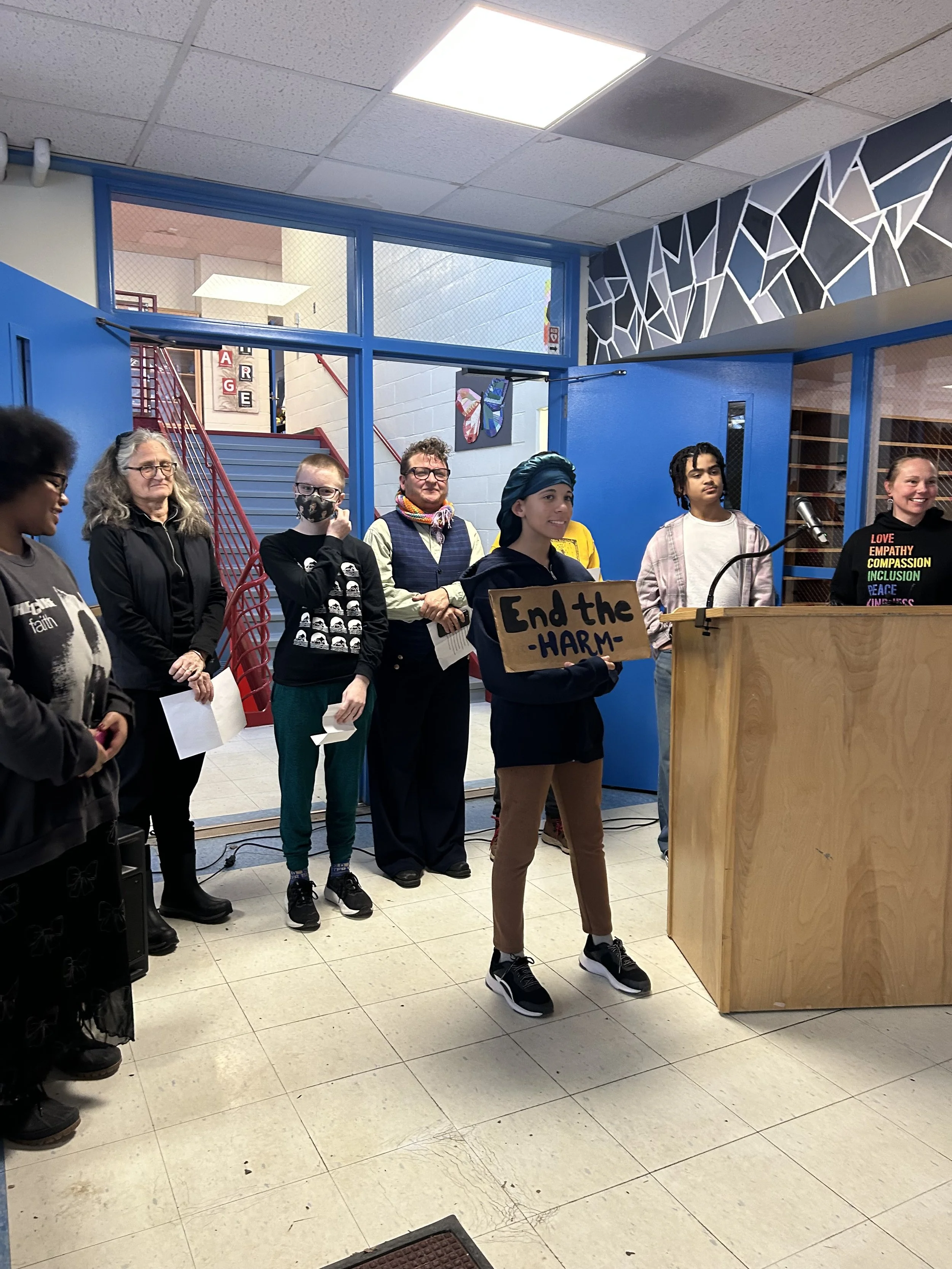
On December 3rd, we co-hosted a press conference with Outright Vermont at Essex Middle School to announce the next phase of Narratives for Change, a statewide campaign calling on policymakers and the Agency of Education to implement student-driven priorities addressing the growing crisis of hazing, harassment, and bullying (HHB) in Vermont schools. You can see coverage about the press conference on WCAX and Colchester Sun.
Education Justice Coalition youth organizer and Colchester High School student Alice Langbauer spoke about the importance of whistleblower protection. Alice experienced increased bullying after reporting it to their school. Their friends felt that they couldn’t speak up because of potential retaliation from peers. “If my school’s policy had included Mandatory Intervention for bullying, I wouldn’t have been so afraid to go to school, because I would know that if anything happened, there would be an intervention, no matter what.”
Caroline Elander shared about racism that her two children faced in Berkshire. During middle school, one of her daughters was urged to report sexually explicit comments from a classmate, but nothing happened when she was called a racial slur at school. She could no longer attend school because of ongoing racist comments. “I don’t feel like educators are given enough help. Right now the staff don’t know how to stop bullying from picking on other kids. There needs to be specific training to support staff to interrupt harm.”
Arena Coryer, now a senior at Colchester High School and organizer with Outright Vermont, explained how she’s experienced racist bullying since middle school. When a classmate continuously made racist comments, Arena requested a restorative justice process to repair the harm and was told by her principal that it “wouldn’t be necessary”. “Due to the school environment it has made it feel like walking into my school is impossible. No matter how many times I've had to call out these types of situations the results have never actually healed anything for me.”
Essex Middle School has made promising efforts to improve how it responds to incidents of hazing, harassment and bullying. They have an equity team in each school and a restorative process for bullying and harassment. Youth in White River Valley School District created their own youth council to process cases of harassment and bullying. Chen shared these developments along with the eerily similar issues raised in current testimonies and a 1999 report on HHB in Vermont. “Why have we not made real progress in the 25 years since the alarm bells on this issue were raised?”
Actions to take before the end of the year:
Attend the Speak Out on Monday, Dec. 15th 3:30-4:45pm. Register here. Use this template to craft your statement.
Send a letter to education stakeholders in Vermont and asking them to include these demands in the policy update.
Have a personal story to share and want to make a bigger impact?
Add one or two paragraphs to the letter below. You can use the following sentence starters to support you: “I am [share your role, are you an educator, student, caregiver]. [Share your story and the ways you’ve been impacted by this issue]. One demand that is important to be is ____ because ____.”
If you’re personalizing your email also personalize the email subject line “Personal Testimony from [name] about HHB Policy Update”